Ivanhoe Mines Reports Strong Copper and Zinc Output as Kamoa-Kakula Expansion Advances
Ivanhoe Mines Reports Strong Copper and Zinc Output as Kamoa-Kakula Expansion Advances
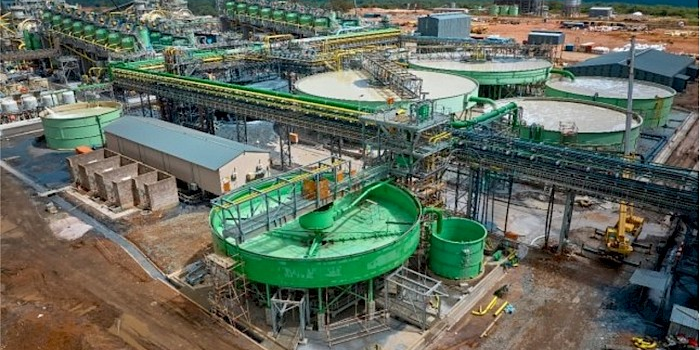
TSX-listed Ivanhoe Mines produced 71,417 tonnes of copper in blister and anode from its Kamoa-Kakula Copper Complex smelter in the Democratic Republic of Congo during the first quarter of the year.
The company reported that total output comprised 63,671 tonnes of copper in anode produced by Kamoa-Kakula’s on-site direct-to-blister copper smelter and 7,746 tonnes of copper in blister produced by the Lualaba Copper Smelter in Kolwezi.
In addition, Kamoa-Kakula’s on-site smelter generated 117,871 tonnes of high-strength sulphuric acid during the quarter, reinforcing its role as both a copper producer and a key supplier of industrial acid to regional mining operations.
Updated Mineral Reserves and Production Outlook
On March 31, Ivanhoe Mines released the results of an updated technical report for the Kamoa-Kakula Copper Complex.
The revised mineral reserve estimate totals 466 million tonnes of ore at an average grade of 2.82% copper, containing approximately 13.1 million tonnes of copper.
The company stated that the updated estimate reflects modifications to mine design and extraction sequencing, incorporating more conservative geotechnical assumptions informed by analysis from international experts.
The technical report also introduced an updated mine plan and production schedule. Under the revised framework, Phase 1, 2, and 3 concentrators are expected to ramp up to a combined steady-state processing rate of 17 million tonnes per year over an estimated 25-year life of mine.
Revised production guidance indicates a ramp-up to more than 500,000 tonnes per year of copper from 2028 onward, positioning Kamoa-Kakula among the world’s largest copper mining operations.
Record Zinc Production at Kipushi
Meanwhile, the Kipushi Mine concentrator delivered another record quarter, milling 196,774 tonnes of ore at an average grade of 36.96% zinc and producing 65,044 tonnes of zinc in concentrate.
This represented a 6% increase compared with the fourth quarter of 2025. For the first time, concentrator recoveries averaged above 90% during the quarter, highlighting operational efficiency gains.
Platreef Expansion Progresses on Schedule
At the Platreef Mine in South Africa, the 800,000-tonne-per-year Phase 1 concentrator processed lower-grade development ore during the quarter while final preparations were completed on Shaft #3.
Ivanhoe confirmed that construction of Shaft #3 and associated underground materials-handling and crushing infrastructure was completed on schedule in late March and is currently undergoing commissioning.
Once fully operational, Shaft #3 is expected to increase hoisting capacity by approximately five times, enabling simultaneous hoisting of ore and development waste a capability not possible with Shaft #1 alone.
The company noted that the upgraded infrastructure will allow the Phase 1 concentrator to transition to continuous feeding of higher-grade production ore in the coming weeks.
Preparatory work for the Phase 2 expansion, scheduled for completion by the end of 2027, is also progressing, with early construction activities on surface infrastructure already underway. Groundbreaking for the 3.3-million-tonne-per-year Phase 2 concentrator is expected shortly.
Supply Chain Risks Linked to Strait of Hormuz Tensions
Ivanhoe founder and co-chairperson Robert Friedland warned that a prolonged closure of the Strait of Hormuz could significantly disrupt global supply chains.
The company has implemented contingency measures across its operations, including strategic diesel procurement, to maintain operational continuity.
Friedland cautioned that disruptions to sulphur supply could have downstream impacts on global copper production, noting that approximately 20% of global copper supply depends on sulphuric acid leaching processes for oxide ores.
“With about 50% of global seaborne sulphur supply potentially constrained, sulphur and sulphuric acid markets are becoming increasingly tight,” he said.
Strategic Advantage in Energy and Inputs
Against this backdrop, Friedland emphasized that Kamoa-Kakula holds a structural advantage as a producer rather than a consumer of sulphuric acid.
The smelter generates high-strength sulphuric acid as a by-product, which is sold to oxide copper mines across the DRC Copperbelt.
He also highlighted the project’s energy resilience, noting that Ivanhoe has refurbished more than 250 MW of hydroelectric capacity in the DRC to power its operations.
An additional 60 MW of renewable energy from a new solar facility with battery storage is expected to come online soon.
Furthermore, Kamoa-Kakula maintains a low diesel consumption rate per tonne of copper produced, strengthening the cost and sustainability profile of its integrated operations.